The Voice Files · Part 2 of 5
The Black Box That Promised to Hear a Lie
Three intelligence officers, a Cold War, and a machine that claimed to catch a liar from the sound of his voice — and the decades-long fight over whether it was real.
In Part 1 we found the thing your ear had been catching your whole life: a faint, fast tremor woven invisibly into the human voice, a vibration of the vocal muscles that shifts when a person is under strain. The London physiologists who pinned it down thought of it as basic science. Within a decade, other people had a very different idea about what to do with it.
If a measurable signal in the voice changes under stress, and lying is stressful, then — the reasoning went — you could build a box that listens to a voice and tells you when someone is lying. No straps. No cuff. No wires. Just a microphone, or even a tape recording made without the speaker's knowledge.
Your instinct reading that is probably the right one: it sounds too powerful, and a little too good to be true. Hold onto that instinct. It turns out to be the most important character in this part of the story.
Three soldiers and a box
In the early 1970s, three retired US Army officers — Allan D. Bell Jr., Charles R. McQuiston, and Wilson H. Ford — left careers built in military intelligence and counterintelligence and founded a company in Springfield, Virginia, with a name that tells you exactly what world they came from: Dektor Counterintelligence and Security.
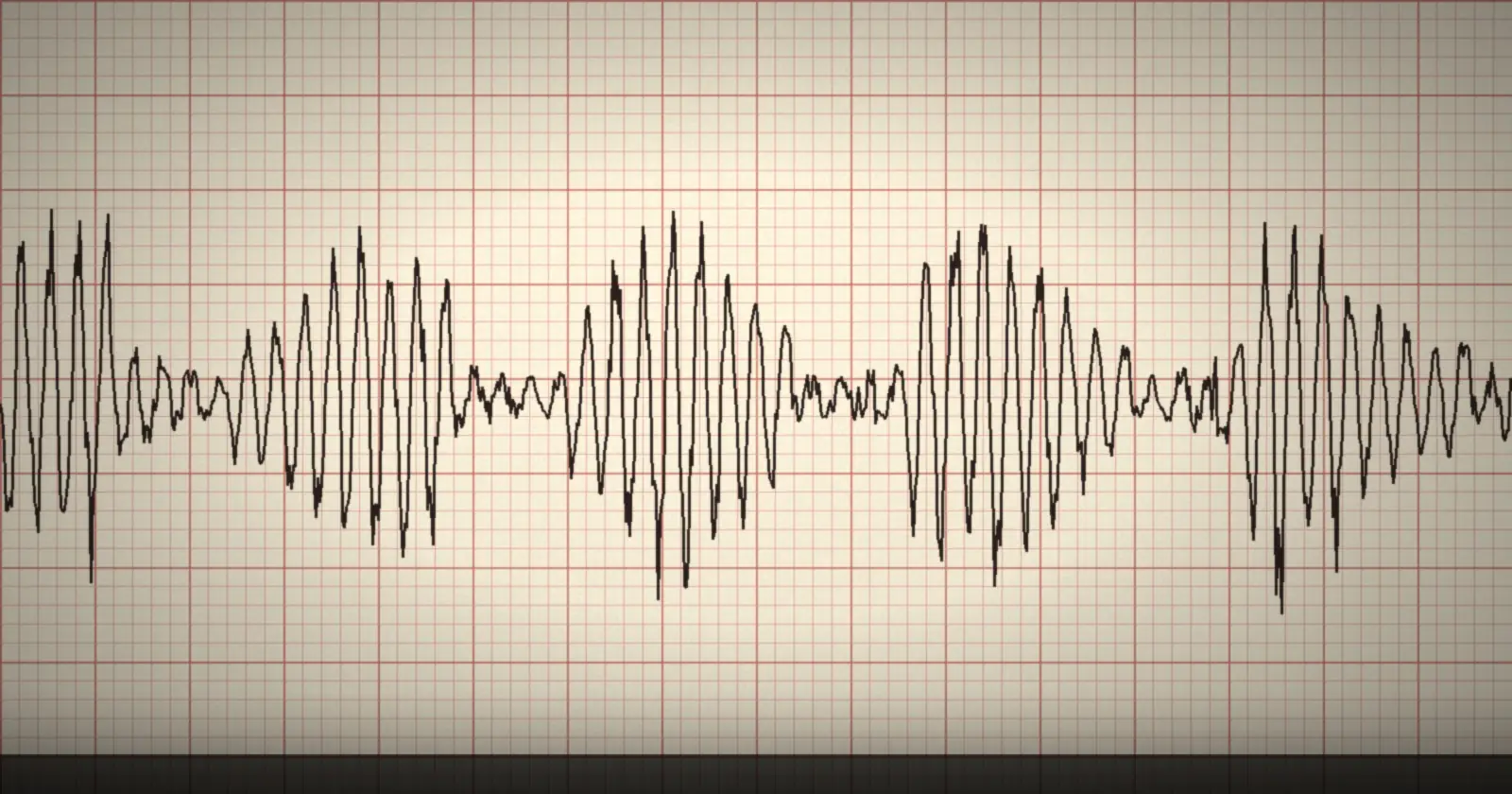
In 1971 they introduced their invention. They called it the Psychological Stress Evaluator — the PSE — and it was the first voice stress analyzer ever sold. By today's standards it looked almost comically analog: a black box that ran a recorded voice through its circuits and printed a jagged trace onto a strip of heated chart paper, the kind used for EKGs, drawn by a hot stylus. An examiner would then read the shapes of those traces, longer and squarer when the box judged the speaker stressed.
Their theory pointed straight back to the London discovery from Part 1. Under stress, they argued, the nervous system clamps down on the involuntary micro-tremor in the vocal muscles, smoothing out a faint frequency flutter that's normally there. The PSE was built to sense that suppression — to detect, in effect, the moment the voice went unnaturally steady under pressure. They patented the method in the mid-1970s and went to market.
The pitch was irresistible to exactly the customers you'd expect. The polygraph had ruled lie detection for half a century, but it was slow, intrusive, and impossible to run on someone who wasn't sitting in the chair. The PSE promised the same forbidden knowledge — is this person telling the truth? — with none of the friction. It could run on a phone call. It could run on a recording made yesterday. Police departments bought it. Government agencies tested it. It spread through the 1970s on a wave of marketing and genuine institutional hunger.
The question that wouldn't go away
Then the scientists got hold of it, and the trouble started.
Through the 1970s, researchers ran the PSE through controlled laboratory tests, and the results were a study in disappointment and intrigue at the same time. In one widely cited 1979 experiment, subjects were given a reward for fooling an interrogator; the PSE's verdicts on who was lying came out no better than chance. As a lie detector — the one job it was sold to do — it simply did not deliver.
But the same body of research kept turning up a stubborn, fascinating asterisk. When subjects were put under measurable mental load — harder and harder mental-arithmetic problems, for instance — the PSE's readings did climb in step with the difficulty, consistently, across people. A prominent 1975 piece in Science captured the strange standoff perfectly: the device was gaining a paying audience even as critics' doubts piled up.
Read those two findings together and you get the real, underrated lesson of the whole episode — the one that quietly governs everything that comes later in this series. The machine appeared to be picking up something genuine: stress, arousal, mental load, printed into the sound of the voice. What it could not reliably do was leap from "this person is stressed" to "this person is lying" — because plenty of honest people under suspicion are stressed, and plenty of practiced liars are calm. The voice was leaking a real inner signal. The mistake was deciding in advance that the signal spelled deception.
The split verdict on the PSE
That didn't stop the institutions from wanting it. The appetite was global and it reached into the military: researchers in the 1970s were already studying whether you could gauge a pilot's stress from the sound of his radio transmissions — reading the strain in a voice crackling down from a cockpit. Wherever there was a high-stakes voice and someone who wanted to know the state of the person behind it, the dream resurfaced.
The original Dektor faded; the company went out of business in the 1990s. But the idea was too seductive to die. By 1988 a successor technology, the Computer Voice Stress Analyzer, had taken over the truth-verification niche in American law enforcement, and voice stress analysis as a category rolled on — still selling, still disputed, right up to the present.
From micro-tremor to voice stress analysis
Meanwhile, on the other side of the wall
While American companies chased the lying voice, a parallel pursuit was unfolding behind the Iron Curtain — and it's the part of this history that remains genuinely murky.
The Soviet scientific tradition had its own deep roots in this soil. Russian psychophysiology, heir to the Pavlovian school, had spent decades on the relationship between hidden internal states and the involuntary signals the body gives off — work serious enough that Western scientists were reviewing it in the pages of Science as far back as the 1950s. The conviction that a person's concealed condition could be read from signals they couldn't consciously control ran just as strong in the East as in the West.
That lineage produced something that still operates today, and still provokes argument: a Russian technology called VibraImage, developed by Viktor Minkin and his St. Petersburg firm Elsys. Where the Americans listened to the voice, VibraImage watches — it analyzes the tiny, involuntary micro-movements of a person's head and face on video and converts them into a score for that person's psychophysiological and emotional state. Different signal, same ancient dream: read what someone is hiding from a flicker they can't suppress. It has reportedly been used for security screening, including at sensitive sites and high-profile events.
Here's where honesty matters more than drama. VibraImage's claims are contested. Independent researchers have raised pointed concerns that the system's inner workings and its validation are difficult to scrutinize from the outside — that you are, to a meaningful degree, asked to trust the box. That criticism is itself part of the intrigue, but it's a warning label, not a thrilling secret: a technology you can't inspect is a technology you can't fully believe.
The half-truth that pointed the way
So by the end of the Cold War the score sat roughly here. The voice clearly carried a real signal of inner state — the half-working stress readings proved that much was no illusion. But the flashy commercial mission, catch the liar, kept collapsing under scrutiny, and the most opaque programs asked for a faith their secrecy couldn't earn.
And quietly, away from the interrogation rooms and the security expos, a completely different kind of work was maturing in university laboratories — much of it in the German-speaking world. Researchers like Klaus Scherer, working in Germany and later Geneva with colleagues such as Rainer Banse in Berlin, weren't trying to catch anyone. They were doing the patient, unglamorous thing: recording emotions under controlled conditions and measuring, parameter by parameter, exactly how feeling and arousal print themselves into the acoustics of speech — into pitch, into pitch variability, into the tiny cycle-to-cycle wobble engineers call jitter and the loudness flutter they call shimmer, into the rhythm and rate of talking. Their results were modest and honest: you can read emotion from a voice far better than chance, though never perfectly. Decades later, that lineage would hand the world standardized acoustic toolkits that today's artificial intelligence runs on.
That sober track — not the lie detectors — is where the real future was being built. And it was about to ask a far more interesting question than any spy ever had. Because if emotion and stress live in the acoustics of the voice, then the door is open to a thought that would have sounded like science fiction in Dektor's day:
Four threads, one idea
What if the voice carries not just your mood — but the early signature of what's happening inside your body?
Next in The Voice Files
Part 3 — When the Voice Started Revealing the Body: the moment researchers stopped asking "is he lying?" and started asking "is she ill?" — and discovered that Parkinson's, depression, and disease itself can leave fingerprints in the sound of a voice, sometimes long before a person notices anything is wrong.
This is where the story turns from spycraft to something that might one day matter to you. Continue to Part 3 →
Quick answers
Does voice stress analysis detect lies?
Controlled studies have generally found voice stress analyzers no better than chance at detecting deception. They can register stress or mental load, but stress and lying are not the same thing — honest people under suspicion are often stressed.
What was the Psychological Stress Evaluator?
The PSE, introduced in 1971 by Dektor Counterintelligence and Security, was the first commercially sold voice stress analyzer. It printed a voice trace on heated chart paper that an examiner interpreted for signs of stress.
Sources & further reading
- Holden, C. (1975). Lie detectors: PSE gains audience despite critic's doubts. Science, 190(4212), 359–362.
- Horvath, F. (1979). Effect of different motivational instructions on detection of deception with the Psychological Stress Evaluator and the galvanic skin response. Journal of Applied Psychology, 64(3), 323–330.
- National Research Council (2003). The Polygraph and Lie Detection. Washington, DC: The National Academies Press.
- Banse, R., & Scherer, K. R. (1996). Acoustic profiles in vocal emotion expression. Journal of Personality and Social Psychology, 70(3), 614–636.
The Voice Files — the full series
A note on this series: The Voice Files explores real, documented history alongside the claims, controversies, and unverified rumors that have always surrounded this field — and it flags clearly when it crosses from established fact into disputed or speculative territory. Voice stress analysis for lie detection, in particular, remains scientifically contested, and several technologies mentioned here are disputed by independent researchers. This series is written for curiosity and entertainment, not as medical, scientific, legal, or professional advice. Nothing here is a diagnosis or a promise of one. Any tool referenced later in the series is intended for personal wellness and self-exploration and produces indicators, not medical conclusions; for any health concern, consult a qualified professional.